

Steel continues to be one of the most important materials used across modern industries, and in 2026 the demand for precision-engineered steel products has increased more than ever. From automotive manufacturing and electrical equipment to furniture production and industrial machinery, businesses require steel products that can support both performance and manufacturing efficiency.
This growing demand has made the CRCA steel sheet an essential material across multiple sectors.
As manufacturing standards continue evolving across India and global markets, understanding the properties and applications of CRCA steel has become increasingly important for manufacturers, fabricators and industrial buyers.
In this article you will know everything about CRCA steel and every detail that you should know.
Definition of CRCA Steel Sheet
The term CRCA steel sheet stands for Cold Rolled Close Annealed steel sheet. It is a specially processed form of steel manufactured through cold rolling followed by annealing treatment to improve strength, finish quality and fabrication flexibility.
Unlike hot rolled steel, CRCA steel undergoes additional processing after rolling, which helps achieve:
- Better dimensional accuracy
- Smoother and cleaner surface finish
- Improved mechanical consistency
- Higher flexibility and formability
The close annealing process is particularly important because it reduces internal stress within the material after cold rolling. This treatment makes the steel softer, easier to shape and more suitable for precision fabrication work.
How CRCA Steel Sheets are Manufactured
The manufacturing process of CRCA steel plays a major role in determining its surface finish, durability and industrial usability.
-
Cold Rolling Process
The first stage of the CRCA sheet manufacturing process involves cold rolling. During this stage, hot rolled steel passes through rollers at room temperature to reduce thickness and improve surface quality.
Cold rolling helps improve:
- Dimensional precision
- Surface smoothness
- Thickness consistency
- Mechanical strength.
This process also strengthens the steel through strain hardening, although it may temporarily reduce flexibility before annealing treatment is carried out.
-
Close Annealing Treatment
After cold rolling, the steel undergoes close annealing treatment under controlled temperature conditions. The steel is heated and cooled gradually to relieve internal stress and restore ductility.
This stage helps:
- Improve flexibility and bendability
- Enhance machinability
- Restore formability
- Reduce brittleness caused by cold rolling
The annealing process is one of the key reasons why CRCA steel becomes suitable for detailed industrial fabrication and shaping applications.
-
Surface Finishing and Quality Inspection
The final manufacturing stage focuses on surface finishing and quality inspection to ensure consistency in finish, thickness and mechanical properties.
Modern production facilities place strong emphasis on:
- Smooth surface appearance
- Uniform thickness accuracy
- Better coating compatibility
- Reliable fabrication performance
These finishing characteristics make CRCA steel highly suitable for industries requiring precision manufacturing and refined product appearance.
Key Properties of CRCA Steel Sheets
The popularity of CRCA steel across different industries is mainly driven by its balanced combination of durability, finish quality and fabrication flexibility.
-
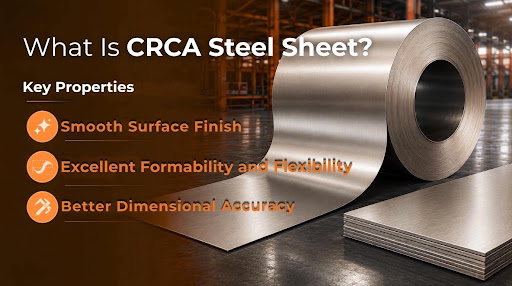
Smooth Surface Finish
One of the biggest advantages of CRCA steel is its smooth and uniform surface texture. This clean finish makes it highly suitable for painting, powder coating and decorative applications. Industries prefer CRCA sheets because smoother surfaces improve final product appearance while reducing the need for excessive finishing work during production.
-
Excellent Formability and Flexibility
CRCA sheet offers strong bending and shaping capability, allowing manufacturers to create detailed components without damaging the material structure.
This makes the material especially useful for industries involved in:
- Automotive component manufacturing
- Electrical panel fabrication
- Furniture production
- Industrial equipment fabrication
Its flexibility supports precision engineering while maintaining structural integrity.
-
Better Dimensional Accuracy
Compared to many conventional steel products, CRCA sheets provide better thickness consistency and dimensional precision. This helps manufacturers maintain tighter tolerances during production processes.
Benefits of Using CRCA Steel Sheets
The increasing use of CRCA material across industries is driven by several practical manufacturing and performance advantages.
Some major benefits of using CRCA steel sheets include:
- Smooth and uniform surface finish
- Better dimensional consistency
- Improved bending and forming capability
- Easier welding and fabrication
- Strong compatibility with painting and coating
- Enhanced appearance of finished products
- Consistent mechanical properties
These advantages help manufacturers improve production quality while also increasing fabrication efficiency. Because of its versatility and reliability, CRCA steel continues to remain one of the most preferred processed steel materials across precision manufacturing industries.
Conclusion
The CRCA steel sheet has become an essential material across modern manufacturing industries. It is because of its smooth finish, dimensional accuracy and excellent fabrication flexibility. CRCA steel supports applications where precision and appearance are equally important.
Better surface quality, improved formability and consistent mechanical properties make CRCA steel highly suitable for industries focused on high-quality production standards. As industrial manufacturing continues advancing in 2026, the demand for reliable and precision-engineered materials is expected to remain strong. For manufacturers seeking durability, efficiency and refined finish quality, CRCA steel continues to be one of the most practical and trusted material choices available today.
Written and Verified by:

SEL Tiger
Bio: SEL Tiger Roofing Sheets manufactures roofing sheets using advanced technology for industrial, commercial and domestic requirements. SEL Tiger Roofing Sheets supplies colour coated and Alu-Zinc coated sheets that offer superior strength, weather resistance, corrosion resistance and long-lasting value for every project.